jules wrote:
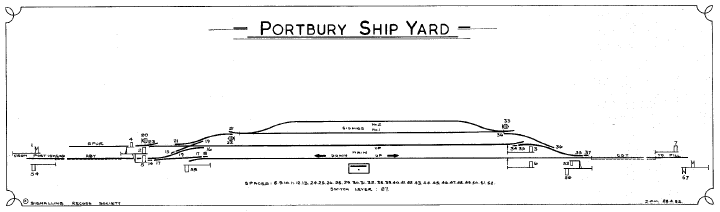
I would caution against it too. Portbury Shipyard was a fairly substantial place back in the 1920s ...
The suggestion is Portbury station itself rather than Portbury Shipyard, and I think the circumstantial evidence is pretty strong.
I have just been leafing through my copy of Reflections on the Portishead Branch and it shows a plan of Portbury station in 1885. At that time the station had a loop and there was a signal box on the south side of the line to the east of the station. A siding diverged from the main line immediately in front of the signal box, exactly as shown in the photo.
At some time Portbury signal box closed and the loop was removed. I could not find any reference to this event in the book, but I should think it a fair bet that it was about the same time that Portbury Shipyard opened in 1918, since there would have been no need for two loops half a mile apart. There cannot have been many stations that had been downgraded like this at such an early date.
The book has a photo of Pill station in 1910 showing a signal box having the same proportions, roof shape and window frames as the box in the photo (however it looks as if it might be brick-built up to window height rather than having wood at waist level).
The box in the photo is constructed of dark stone with light stone quoins, (Pennant Sandstone and Bath Stone?) which is very characteristic of Victorian buildings in the Bristol area.
The train is longer than might be expected on a purely rural line; trains on the Portishead branch in the late 20's and 30's had up to 7 coaches, and the class of loco is appropriate.


 Both seem to be strong contenders, I think you just have to make your own decision.